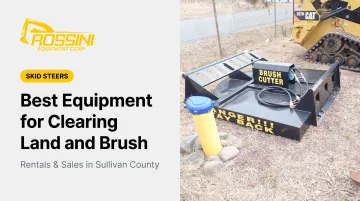
Many crews struggle with tight access points, dense underbrush, and rock ledge that stops standard equipment cold. The result: stalled schedules, torn-up soil, and budgets that balloon before the first tree comes down.
This guide breaks down the best equipment types for clearing land and brush, how to match machines to your site conditions, and what to check before committing to a rental.
TL;DR
- Excavators, bulldozers, skid steers, mulchers, wheel loaders, and stump grinders each suit a specific clearing task.
- The right mix depends on acreage, vegetation density, terrain, and your end goal.
- Renting gives access to a well-maintained fleet without ownership overhead.
- Rock ledge and limited access are the two factors most likely to derail Hudson Valley projects.
Overview of Land-Clearing Equipment in the Hudson Valley and Sullivan County Region
Land-clearing equipment covers the heavy machines and attachments used to remove trees, brush, stumps, rocks, and debris before a site is ready for construction, farming, or land management.
Sullivan County's mix of wooded hillsides, exposed bedrock, and steep grades means one machine rarely does the whole job. Common combinations include:
- A mulcher for dense underbrush and small growth
- An excavator for stumps and root systems a mulcher can't touch
- Breaker attachments for exposed bedrock and rock ledge
Demand here isn't seasonal noise, either. NYSEG reported clearing 354 circuit-miles and removing 1,500 hazard trees in Sullivan County in 2021 alone, with more mileage planned across the region. Municipalities, utility companies, developers, and landscapers all draw from the same pool of equipment types.
The sections below cover what each machine does best and where it fits into a clearing project.
Top Equipment for Land and Brush Clearing
Selection should come down to versatility, terrain compatibility, and attachment options, not just horsepower on a spec sheet. Here's how the major equipment categories stack up.
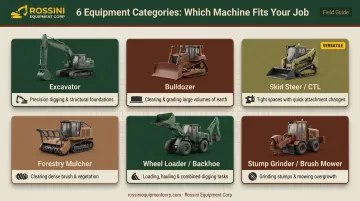
Excavators
Excavators use hydraulic arms fitted with grapples, shears, thumbs, or buckets to remove trees, stumps, roots, and rocks with real precision. That control matters when you're working near a structure, a property line, or a septic field where a wrong swing means a repair bill.
Rossini's fleet includes both a CAT 308E2 CR 9-ton compact excavator and a Hitachi ZX290LC-5N 31-ton hydraulic excavator, giving crews a size option for both tight residential lots and larger commercial clears.
| Attribute | Details |
|---|---|
| Best For | Selective tree/stump removal, precision clearing near structures |
| Key Attachments | Grapples, shears, thumbs, buckets |
| Ideal Terrain | Uneven, sloped, or confined sites |
Bulldozers
Bulldozers push over trees, pile brush, and grade land fast using a front-mounted blade. When you've got 15+ open acres to open up before winter, nothing clears volume faster.
They trade precision for power, though. A dozer isn't the tool for working three feet from a property line or threading between mature trees you want to keep standing.
| Attribute | Details |
|---|---|
| Best For | Large-scale clearing and initial site grading |
| Key Attachments | Various dozer blades (straight, universal, angle-tilt) |
| Ideal Terrain | Open, wide acreage with room to maneuver |
Skid Steers and Compact Track Loaders
Skid steers and CTLs earn their reputation on adaptability. Swap the bucket for a mulching head, grapple, or auger, and the same base machine handles brush clearing, debris hauling, or fence-post drilling.
Tracked models add flotation on soft or muddy ground, a real advantage during Sullivan County's spring thaw. Wheeled skid steers still win on hard, dry surfaces where speed matters more than ground pressure.
Rossini stocks a John Deere 318G skid steer (65 HP, 1,945 lb rated capacity) and a CAT 257D compact track loader (74 HP, 3,100 lb capacity). Both machines pair with a mini skid steer mulcher, grapple attachments, and the AGT-RC72 six-foot brush cutter, which handles material up to 4 inches in diameter.
| Attribute | Details |
|---|---|
| Best For | Brush cutting, debris hauling, small-to-mid lot clearing |
| Key Attachments | Mulchers, grapple buckets, brush cutters |
| Ideal Terrain | Tight spaces, soft or uneven ground (CTLs) |
Forestry Mulchers
Forestry mulchers shred brush and small-to-medium trees into mulch right on-site. That eliminates a debris hauling bill and leaves behind a layer that helps hold soil moisture.
Don't expect one to plow through mature timber, though. Manufacturer specs typically cap efficient processing around 6-8 inch trees. A USFS field study measured average mulcher production at 0.57 acres per hour, ranging from 0.21 to 0.89 acres per hour depending on stand density and terrain. Treat any acres-per-day number as a starting estimate, not a guarantee.
| Attribute | Details |
|---|---|
| Best For | Overgrown lots, underbrush, and forestry management |
| Key Attachments | Mulching head (standalone or skid steer/excavator-mounted) |
| Ideal Terrain | Wooded, uneven terrain (avoid steep grades) |
Wheel Loaders and Backhoes
Wheel loaders move high volumes of cleared debris with a large front bucket. Backhoes combine that same front-loader function with a rear digging arm, useful when a job calls for hauling one hour and trenching around a root ball the next.
The appeal is flexibility: one machine covers two jobs instead of renting a second unit for the site.
| Attribute | Details |
|---|---|
| Best For | Moving large debris volumes; multi-task small-to-mid sites |
| Key Attachments | Buckets, forks, grapples, backhoe arm |
| Ideal Terrain | Firm, semi-developed ground |
Stump Grinders and Brush Mowers
Stump grinders finish what the bigger machines leave behind, grinding stumps below grade so a site is actually ready for grading or planting. Grinding depth varies a lot by model: some units cut 12 inches below grade, others exceed 25 inches. Specify your depth requirement rather than assuming a standard.
Brush mowers handle the ongoing side of clearing: thick grass, weeds, and light brush that create fire-hazard fuel loads if left standing.
| Attribute | Details |
|---|---|
| Best For | Final stump removal and thick vegetation upkeep |
| Key Attachments | Grinding wheel; rotary cutter/blade |
| Ideal Terrain | Varies by model size; suited to finishing-stage work |
How to Choose the Right Equipment for Your Land-Clearing Project
The most common mistake we see: crews try to run an entire job with one oversized (or undersized) machine. Most experienced operators combine two or three machines instead, which usually finishes faster and disturbs less soil.
Match Equipment to Site Conditions and Project Goals
A quarter-acre residential lot with scattered brush needs a skid steer and a brush cutter. A 20-acre former farm field overrun with saplings calls for a mulcher, possibly paired with a dozer for grading afterward. Match machine scale to job scale before anything else.
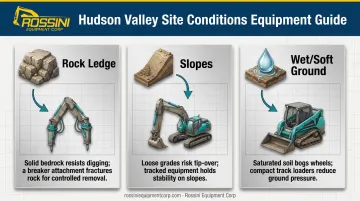
Hudson Valley properties bring specific headaches:
- Rock ledge limits blade depth and can damage undercarriages on the wrong machine
- Slopes favor tracked equipment over wheeled for stability and traction
- Wet or soft ground in spring rewards CTLs, which spread weight and reduce ground pressure compared to standard tires
Project goals also drive clearing depth. Construction prep, agricultural reclamation, and wildfire fuel reduction all demand different depths: a construction site needs stumps ground below grade, while fuel-reduction work near a home might only require mowing brush within 30 feet, per NYSDEC Firewise guidance, without full removal.
Confirm Permits, Then Decide Whether to Rent or Buy
New York requires construction stormwater permit coverage once soil disturbance reaches 1 acre or more, which usually means a SWPPP. Wetlands, stream corridors, and steep slopes may trigger additional local or state review, so confirm zoning rules with your town before equipment arrives.
Permits sorted, the rent-or-buy decision comes down to job frequency. For most one-time or seasonal jobs, renting wins:
- No storage costs between projects
- Access to a range of machine sizes without owning each one
- Maintenance and servicing handled by the rental company
- Predictable daily, weekly, or monthly costs
Local providers like Rossini Equipment Corp handle delivery and pickup directly, cutting coordination time on tight schedules.
Why Local Crews and Property Owners Rent from Rossini Equipment Corp
Rossini Equipment Corp is based in Monticello and built on a family construction history that goes back to 1963. Founder Joseph Rossini spent years running jobs himself before starting the rental business in 1998, which means the fleet is chosen with rock ledge, tight access, and schedule pressure already in mind.
What that looks like in practice:
- Well-maintained machines that arrive ready to work, from the CAT 308E2 excavator to the John Deere 318G skid steer
- In-house transportation, so delivery and pickup don't depend on a third-party trucking schedule
- On-site servicing to cut downtime on active jobs
- Flexible daily, weekly, or monthly terms, with weekly rates typically running about three times the daily rate
That same hands-on approach carries through to every job site Rossini reaches, from Monticello and Middletown to Liberty, Port Jervis, and the broader Hudson Valley and Sullivan County region. If you're not sure which machine fits your site, call (845) 794-1066 or email office@rossiniequipmentcorp.com for a recommendation based on your acreage and terrain.
Conclusion
No single machine handles every land-clearing job well. Success comes from matching equipment to acreage, vegetation density, and terrain, not defaulting to whatever has the biggest engine.
Before finalizing your equipment list, walk the site, note the rock outcrops and access points, and think about how the land will be used once it's cleared.
Ready to plan your next project? Contact Rossini Equipment Corp for equipment recommendations and current rental availability.
Frequently Asked Questions
What is the most efficient way to clear land?
Combining machines works best: use a mulcher or dozer for bulk vegetation, then an excavator for roots and stumps. This approach clears land faster than relying on one machine or manual labor alone.
Is a dozer or excavator better for clearing land?
Dozers push over large volumes of brush and trees quickly on open land. Excavators offer more precision for uprooting stumps and working near structures or in tight spaces.
How many acres can a forestry mulcher clear in a day?
Output varies widely by mulcher size, vegetation density, and terrain. Talk to a rental specialist for a realistic estimate based on your specific site conditions.
What equipment is needed for land clearing?
Most projects rely on a combination of excavators, bulldozers, skid steers or compact track loaders (CTLs), and specialized tools like mulchers and stump grinders, depending on the job's scale.
What is the best equipment for clearing thick brush?
A skid steer or compact track loader fitted with a mulcher or brush-cutter attachment is generally the most efficient choice for dense brush.
Is it cheaper to rent or buy land-clearing equipment?
Renting is typically more cost-effective for one-time or seasonal projects since it avoids purchase costs, storage, and maintenance while still providing access to well-maintained machines.