Introduction
Construction, utility, and landscaping work across New York runs on borrowed iron. Very few contractors own every excavator, skid steer, or compactor a project demands, and most don't need to.
The bigger challenge is finding equipment that's actually ready to work. Contractors in Sullivan County, the Hudson Valley, and the greater NY metro area regularly deal with machines that show up late or break down mid-job. Just as often, the equipment simply isn't matched to the terrain, whether that's rock ledge in Monticello or a tight lot in Middletown.
This guide breaks down what's available to rent, why renting often beats buying, how to vet a rental partner, and what New York's tax and cost rules mean for your bottom line.
Key Takeaways
- Renting reduces upfront costs and provides access to newer, well-maintained equipment
- NY rental fleets cover earthmoving, lifting, compaction, and specialty equipment
- Local jobsite experience and in-house delivery reduce costly downtime risk
- Confirming NY sales tax and rental terms upfront prevents billing surprises
Types of Heavy Equipment Available for Rent in New York
New York jobsites don't play by one set of rules. A crew working a tight NYC lot faces completely different access constraints than a crew clearing wooded, rock-strewn acreage in the Hudson Valley. Rental fleets need enough range to match both.
Earthmoving & Excavation Equipment
Excavators, backhoes, and skid steers form the backbone of utility work, grading, and site prep across New York. Size and configuration matter as much as machine type.
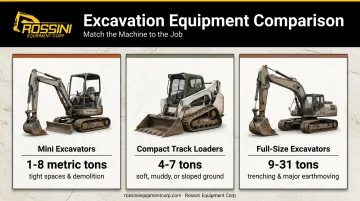
- Full-size excavators (9 to 31 tons) handle deep trenching, foundation work, and major earthmoving
- Compact track loaders grip soft, muddy, or sloped ground better than wheeled skid steers
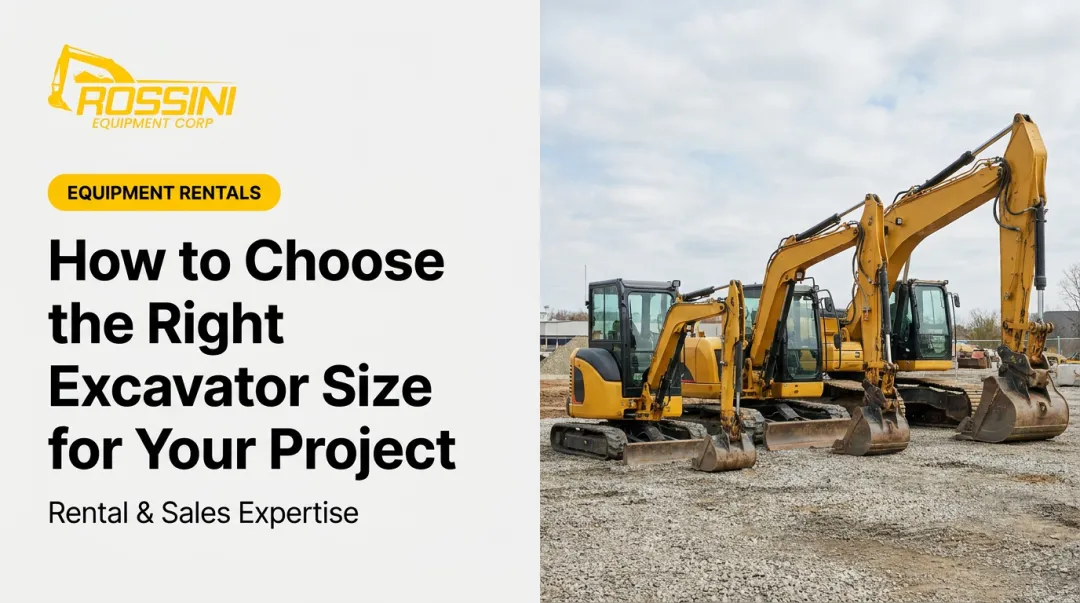
- Mini excavators (1 to 8 metric tons) fit backyards, utility corridors, and demolition sites where full-size machines can't go, per Construction Equipment's mini excavator buying guide
Rossini Equipment Corp's fleet reflects this range, from a 1-ton AGT mini excavator that fits through a standard gate to a 31-ton Hitachi hydraulic excavator for major earthworks. John Deere skid steers and CAT track loaders round out the lineup, sized for tight driveways and soft terrain alike.
Material Handling & Lifting Equipment
Forklifts, telehandlers, and aerial or boom lifts show up constantly on construction, utility, and municipal projects, especially where materials need to move vertically or workers need elevated access.
Operator-rated, well-inspected lifting equipment isn't optional on public and commercial contracts. Aerial lifts require trained, authorized operators, and powered industrial trucks like telehandlers need documented training and evaluation before anyone touches the controls. Skipping that verification step creates liability, not just inefficiency.
Compaction, Site Prep & Trucking Equipment
Compactors, rollers, dump trucks, and trailers round out the site-prep and hauling side of most projects. These machines see heavy, continuous use during grading and material transport phases.
- Compactors and rollers achieve required soil or paving density before pours or paving begin
- Dump trucks and trailers move excavated material off-site or bring aggregate in
- Longer rentals benefit from on-site servicing, since a compactor or hauler sitting idle for repairs costs real project days
Rossini Equipment Corp runs its own trucks and trailers for delivery, pickup, and hauling and removal work, keeping equipment logistics in-house rather than relying on a third-party carrier's schedule.
Specialty Equipment & Skilled Operators
Some jobs, particularly municipal, utility, or complex excavation work, benefit more from an operator-included rental than a machine-only one. Handing an inexperienced crew member the controls of a 30-ton excavator on rock ledge is how schedules slip and budgets blow past estimates.
Rossini's Full Hire Services pair equipment with operators who bring decades of field experience in excavation, grading, rock and concrete breaking, and demolition. That matters most on Sullivan County terrain, where a dig can start in workable topsoil and hit solid bedrock before lunch. Operators who know that pattern adjust technique before it costs a day.
Benefits of Renting Equipment vs. Buying in New York
Buying heavy equipment ties up capital that could otherwise cover labor, materials, or the next job's mobilization costs. The American Rental Association estimates its members hold roughly $213 billion in equipment at original cost, a figure that underscores just how capital-intensive ownership becomes at scale.
That capital lock-up hits harder in the New York market, where yard space and storage costs run high across Sullivan County and the Hudson Valley.
Contractor behavior backs up the shift toward renting. Seventy-two percent of contractors surveyed said they'd rented equipment in the past 12 months, up from 69% the year before, according to Equipment World's 2025 contractor survey.
Renting solves several problems at once:
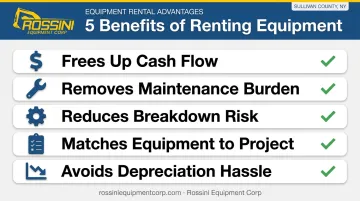
- Frees up cash flow for labor, materials, or other project costs instead of a large capital outlay
- Removes maintenance burden since the rental company handles repairs, servicing, and storage between jobs
- Reduces breakdown risk by giving access to newer, well-maintained machines instead of aging owned equipment
- Matches equipment to the project, letting you size up or down without a long-term financial commitment
- Avoids depreciation and resale hassle on machines that would otherwise sit idle for months between uses
Still, there's no universal percentage that proves renting always beats buying. The math depends on utilization, maintenance costs, and how often the machine would actually run if you owned it. For contractors who don't need a given machine 200+ days a year, renting usually wins that comparison outright.
How to Choose the Right Equipment Rental Company in New York
Not every rental company delivers the same experience, and the difference shows up fast once a machine hits the ground. A few checks upfront save real headaches later:
- Verify equipment condition and maintenance records: well-maintained machines break down less, and a company that can't produce service history is a red flag
- Confirm in-house transportation versus third-party delivery: a provider that owns its trucks controls its own schedule, while one that outsources delivery doesn't
- Assess local jobsite experience: familiarity with rock ledge, tight urban access, and seasonal weather steers crews toward the right machine before wasting a rental day
- Check rental term flexibility: daily, weekly, and monthly options should match your actual project timeline, not force you into an oversized commitment
- Review safety record and certified equipment: especially critical for municipal and utility contracts with compliance requirements
- Evaluate breakdown response time: ask how fast they swap a machine if something fails, since downtime on a rented unit means downtime on your schedule and invoice
A provider with decades of hands-on field experience, not just a large fleet, tends to answer these questions faster and more specifically.
Understanding Equipment Rental Costs and Tax Considerations in New York
Rental rates in New York move based on a handful of factors, and knowing them helps you budget realistically before a project starts.
| Factor | Impact on Rate |
|---|---|
| Equipment type & size | Larger, specialized machines cost more per day than compact units |
| Rental duration | Weekly and monthly rates typically offer a lower daily equivalent than single-day rentals |
| Delivery distance | Farther delivery locations usually add transport cost to the quote |
| Seasonal demand | Peak construction season can tighten availability and affect pricing |
Delivery distance matters less when the provider manages logistics directly. Rossini Equipment Corp's in-house transportation team handles delivery and pickup across Sullivan County and the Hudson Valley, keeping that line item predictable.
Is equipment rental taxable in New York? Generally, yes. New York's definition of a taxable sale explicitly includes rentals and leases of tangible personal property. Delivery charges tied to that rental are typically part of the taxable receipt too, according to New York's Publication 750 sales tax guide.
Exact combined rates vary by jurisdiction, so confirm specifics with NYS tax guidance or a tax professional before finalizing a project budget.
Before signing anything, read the rental agreement closely for:
- Damage liability terms and who's responsible for what
- Fuel policy (full-to-full versus prepaid options)
- Overtime charges and late-return fees
These terms differ by provider, and they're usually negotiated directly rather than published as a fixed policy. Ask before you sign, not after a surprise line item shows up on the invoice.
Why Sullivan County & Hudson Valley Contractors Choose Rossini Equipment Corp
Rossini Equipment Corp didn't start as a rental company chasing a trend. It began as a subsidiary of Rossini Contractors, a family construction business with roots going back to 1963. That means Rossini backs today's equipment recommendations with over 60 years of combined jobsite experience, not a sales script.
That experience now operates out of an expanded yard and office in Monticello, NY, supporting Sullivan County, Orange County, and the broader Hudson Valley with:
- An in-house transportation team that handles delivery and pickup directly, cutting out third-party coordination delays
- On-site servicing that minimizes downtime on active job sites
- Secure short- and long-term parking for commercial vehicles and heavy equipment
- A project portfolio that includes major public and utility clients like Con Edison, NYC DOT, the NYC Parks Department, and the Port Authority of New York and New Jersey
That client list isn't decoration. Public agencies and utilities don't hire vendors that show up late or with poorly maintained machines, and they don't tolerate safety gaps on active infrastructure work.
If your next project needs equipment that arrives on time and ready to work, call Rossini Equipment Corp at (845) 794-1066 for flexible daily, weekly, and monthly rental rates on well-maintained equipment.
Frequently Asked Questions
Is equipment rental taxable in New York?
Generally, yes. New York's sales tax definition includes rentals and leases of tangible personal property, and delivery charges are usually part of the taxable receipt. Confirm the exact rate with NYS tax guidance or a tax professional for your project.
What equipment is typically available for rent?
Common categories include excavators (mini through full-size), skid steers, compact track loaders, aerial lifts, compactors, and trucks or trailers. Availability varies by provider, so confirm specific inventory before you book.
Is there an equipment rental app?
Many larger rental companies now offer online booking platforms. Rossini Equipment Corp handles scheduling directly by phone or email, which often gets you a faster, more personalized quote than a self-service app.
How much does it cost to rent heavy equipment in New York?
Costs vary by equipment type, rental duration, and delivery distance, so there's no single flat rate. Contact Rossini Equipment Corp at (845) 794-1066 for an accurate quote based on your project.
Do I need a license or certification to operate rented equipment?
Certain machines, including aerial lifts and telehandlers, require trained and evaluated operators under OSHA rules. Rossini Equipment Corp can provide skilled operators through its operator hire services when your crew doesn't have certified personnel on hand.
What's the difference between renting and leasing construction equipment?
Rental covers short-term, project-specific access, often daily, weekly, or monthly. Leasing is a longer-term commitment, sometimes running 60 months or more, and suits predictable, ongoing equipment needs rather than a single job.