Rent something too small, and you're repositioning the machine every ten minutes or discovering it can't reach the bottom of your trench. Rent something too large, and it can't fit through the gate, costs more to transport, or sits half-idle while you pay full daily rates.
Size selection affects cost, schedule, safety, and whether the machine can even get to the work area. In Sullivan County and across the Hudson Valley, rock ledge, narrow rural roads, and tight residential lots make this decision even more consequential.
This guide breaks down excavator size classes, the real-world factors that should drive your choice, and how to match machine size to your specific project type.
Key Takeaways
- Excavators span four classes—mini, midi, standard, and large—each suited to different sites.
- Tonnage alone won't tell you if a machine fits; dig depth and access matter too.
- Oversized equipment wastes money and access; undersized equipment slows progress and risks rework.
- Hudson Valley terrain, like rock ledge and tight lots, often dictates size more than project type.
- A local rental partner who knows your terrain helps you avoid a wrong-size machine.
Understanding Excavator Size Categories
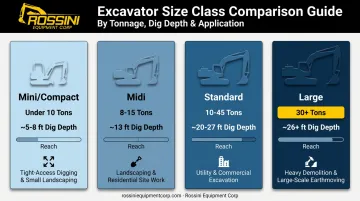
Excavators are classified primarily by operating weight, measured in tons. That weight determines available power, reach, and dig depth. Manufacturers don't always agree on exact cutoffs. Komatsu, for instance, defines its mid-size class as 12 to 34 metric tons, while other brands draw the line elsewhere. Treat class names as a starting point, not a guarantee.
Mini and Compact Excavators
Generally under 10 tons, mini and compact excavators are built for tight-access, low-impact work. Rossini's AGT QH12, a 1-ton mini excavator with a 13.5 HP engine, fits through a standard gate and digs to about 5.4 feet.
Best-fit applications include:
- Sewer and water line repairs in backyards
- Small landscaping and drainage jobs
- Indoor demolition
- Multi-location projects requiring easy trailer transport
Many models in this class feature zero or near-zero tail swing, meaning the rear of the machine stays within the track width during rotation. That matters when you're working next to a fence, a foundation wall, or a finished lawn you don't want torn up.
Midi Excavators
Stepping up to roughly 8-10 tons through the mid-teens, midi excavators trade a bit of the mini's tight footprint for real digging power. Rossini's CAT 308E2 CR, a 9-ton compact-radius machine, digs to 13 feet 6 inches and reaches nearly 23 feet at ground level.
This size suits landscaping contractors and small commercial sites that have outgrown a mini's dig depth but still need to maneuver in confined areas.
Standard (Crawler) Excavators
Running roughly 10 to 45 tons, standard crawler excavators are the most common class on commercial and municipal job sites. Rossini's CAT 313F L GC, a 14-ton machine, digs to 19 feet 9 inches and reaches almost 27 feet.
Their hydraulic systems support multiple tool attachments, from breakers to augers, which makes this class the workhorse for utility installation, site development, and larger foundation excavation.
Large Excavators
Starting around 30 tons and climbing well past 45, large excavators handle major demolition, mass excavation, and mining-scale work. Rossini's Hitachi ZX290LC-5N, at 31 tons, sits at the entry point of this class, digging to nearly 26 feet with a reach of over 36 feet.
Two tradeoffs come with this size:
- Transport requires oversized trailers and permits: NYSDOT requires a Special Hauling Permit for loads exceeding standard dimensions or weights, so route planning matters before the machine leaves the yard.
- Site access needs advance planning, since wide undercarriages and long tail swings don't work on narrow rural roads or tight lots.
Key Factors to Consider When Choosing the Right Excavator Size
Tonnage gets you in the right ballpark. These factors determine whether the machine actually performs on your specific job.
Digging Depth and Reach
Projects like utility trenching or foundation work require a specific maximum dig depth and reach. That's tied to boom and arm configuration, not just overall machine weight. Two excavators with identical tonnage can have very different dig capability depending on stick length.
Undersized reach forces repeated repositioning, which slows the entire digging cycle and adds hours to a job that should have taken one pass.
Lifting and Load Capacity
Lifting capacity depends on counterweight and hydraulic power combined with lift radius. Weight class alone doesn't answer the question.
A common question we hear: what size excavator lifts around 4,000 pounds? Deere's lift chart for its 135 P-Tier shows a rated capacity of 4,460 lbs over the front at a 25-foot radius and 5-foot lift height. That places the load squarely in mid-size to standard territory, depending on how far it sits from the machine.
Always check the manufacturer's lift chart for your exact radius and height before committing to a size.
Worksite Access and Space Constraints
Tight residential lots, rural roads, and confined utility corridors across Sullivan and Orange County restrict both machine footprint and how you get equipment there in the first place.
Tail swing becomes a critical spec here. A machine with a wide rear swing radius might dig fine but clip a fence post or a parked vehicle every time it rotates.
Ground Conditions and Terrain
Soft or finished sites call for lighter-footprint machines that won't tear up lawns or driveways. Rocky or hilly terrain, common throughout the Hudson Valley, favors tracked machines with strong breakout force and the right track shoe width.
A dig that starts in workable topsoil in Monticello can hit solid bedrock before lunch. That's exactly why rock removal projects typically pair a full-size excavator with a hydraulic breaker attachment kept on standby.
Attachment and Hydraulic Compatibility
Attachments like augers, breakers, thumbs, or grapples each require specific hydraulic flow and pressure. Rossini's brush cutter and wood chipper attachments, for example, need 11-16 GPM depending on the model. That flow requirement can determine which excavator size class you actually need, regardless of how much digging the job itself requires.
Budget and Rental Duration
Larger machines cost more to rent, operate, and transport. For occasional or variable-scope projects, renting the correctly sized machine for each job avoids paying for capacity you don't need.
At Rossini, daily rates illustrate the jump between classes:
| Class | Model | Daily Rate | Weekly Rate |
|---|---|---|---|
| Mini (1-ton) | AGT QH12 | ~$300 | ~$900 |
| Midi (9-ton) | CAT 308E2 CR | $600 | $1,800 |
| Standard (14-ton) | CAT 313F L GC | $800 | $2,400 |
| Large (31-ton) | Hitachi ZX290LC-5N | $1,300 | $3,900 |
Matching Excavator Size to Your Project Type
Once you've weighed depth, lift, access, and attachments, the picture usually points to a clear class:
- Utility and municipal trenching typically calls for midi to standard classes, enough reach and depth without the transport hassle of a large machine.
- Residential and landscaping work suits mini to midi excavators, especially where lawns, fences, or narrow gates limit footprint.
- Commercial site development or demolition often requires standard to large machines with the breakout force and lift capacity larger projects demand.
Renting vs. Owning for Your Workload
Once you've matched a class to the job, the next question is whether to own or rent it. Many contractors keep one mid-range machine on hand for routine work and rent larger or smaller units only for outlier jobs. This controls both cost and downtime; you're not paying to own capacity you rarely use.
When deciding what to rent versus keep on standby, look past the current job. Evaluate your upcoming project pipeline. A single mid-size machine that covers 80% of your work, backed by a rental relationship for the other 20%, usually beats owning a fleet sized for your busiest month.
How Rossini Equipment Corp Can Help
Rossini Equipment Corp's roots trace back to 1963, when the Rossini family first got into construction. Founder Joseph Rossini built the rental business in 1998 on that same field experience, and he's dealt with rock ledge, tight access, and schedule pressure firsthand. He knows what happens when the wrong-size machine shows up.
That experience shapes how Rossini approaches every rental request. Instead of steering you toward the biggest machine available, the team assesses site conditions, soil type, gate width, and dig depth requirements, then matches equipment to what the job needs.
Working with Rossini gets you:
- Well-maintained equipment that arrives ready to work, no delays troubleshooting a machine on day one
- Flexible daily, weekly, and monthly rental rates across all four size classes
- An in-house transportation team for delivery and pickup, handling loading and route logistics directly
- On-site servicing to minimize downtime if a mechanical issue comes up mid-project
That local knowledge extends across the region: Rossini serves contractors, municipalities, utility companies, and property owners throughout Sullivan County, Orange County, and the greater Hudson Valley.
Conclusion
Choosing the right excavator means matching the machine to your actual site conditions and project scope, not grabbing the most popular or biggest model on the lot.
Digging depth, lift capacity, and access constraints should drive that decision, not convenience or what you rented last time.
Equipment needs shift as projects evolve. A job that starts as straightforward trenching can turn into rock removal by afternoon. Revisit your size decision on each job and talk through the specifics with Rossini Equipment Corp, a local rental partner who knows Sullivan County terrain inside and out.
Frequently Asked Questions
What are the three types of excavators?
The three main classes by weight are mini/compact (under 8-10 tons), standard (roughly 10-45 tons), and large (45+ tons). Midi excavators form an additional mid-tier class between mini and standard.
What size excavator do I need to lift 4,000 lbs?
This depends heavily on lift radius and counterweight, but a roughly 4,000-lb load typically requires a mid-size to standard-class excavator. Always check the manufacturer's lift chart for your specific load radius and height.
How big is a 20-ton excavator?
A 20-ton class machine typically digs 20-22 feet deep with a ground-level reach around 32 feet, and needs roughly 10 feet of transport width. It falls within the standard size category common on commercial job sites.
What's the difference between a mini excavator and a standard excavator?
Mini excavators weigh under 8-10 tons, dig 5-10 feet deep, and suit tight-access residential work. Standard excavators run 10-45 tons, dig 20+ feet, and handle heavier commercial and municipal jobs.
Should I rent or buy an excavator for my project?
Infrequent or variable-scope work favors renting the right size for each job, avoiding the cost of owning capacity you don't regularly use. Consistent, high-volume use may justify ownership.
How do I know if I need a long-reach excavator?
Long-reach models suit jobs with obstacles, water crossings, or sloping work where the machine can't get close to the dig point. They trade digging force for extended envelope, so only specify one when that extra reach is essential.